
Spring Job Market, Fall Enrollment, Tenure Bans, Trust in Higher Ed…and More
Finding Equilibrium Spring Recap and Update


Where did the Spring semester go??? With the end of the term on us, we’ll revisit the topics we covered in Finding Equilibrium this semester and provide updates where relevant. In the process, we’ll share a number of links to get you started on your summer reading. What *did* we write about this spring? Let’s take a whirlwind tour…
The Job Market for the Class of 2026: What’s Happening?
In late December, the headlines were all about the coming hiring collapse for Spring 2026 graduates – many claiming AI was to blame. You had to go back to 20-21 to find a more sobering NACE fall survey of employer hiring intentions. Our view at the time? The job market was certainly weaker, though not a collapse, and there was little evidence that AI was taking entry jobs broadly – at least not yet.
NACE’s Spring 2026 employer survey of hiring intentions is now out and those responding planned on hiring 5.6% *more* new graduates in Spring 2026, relative to Spring 2025 – and a big swing from the 2.4% *decrease* reported in Fall 2025. The NACE study includes only about 185 companies, so we will see where placement rates actually land for the class of 2026.1
The top 5 industries increasing hiring in the NACE report were Information, Engineering Services, Wholesale Trade, Construction, and Miscellaneous Professional Services. The top 5 pulling back on hiring were Utilities, Computer/Electronics Manufacturing, Food and Beverage Manufacturing, and Chemical (Pharmaceutical) Manufacturing.
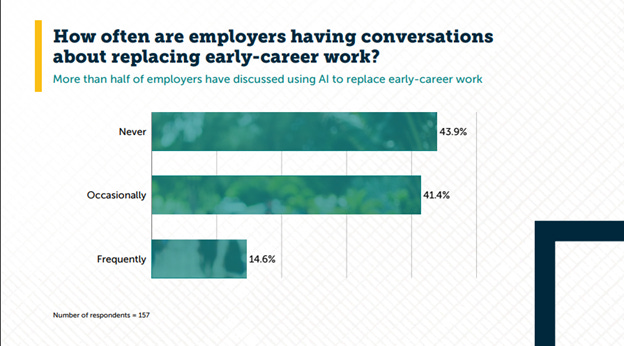
The NACE report also digs into how AI is impacting employer hiring practices and entry-level jobs. Only 28% of those surveyed said they were seeking job candidates with AI skills and 52% said that AI had not reduced the need for entry-level workers’ tasks. But, some 56% said they were occasionally/frequently having conversations about AI replacing early-career work.
Source: NACE.
We will revisit the job market in the Fall, but this more positive take on job prospects for our Spring grads was welcome news…
The Enrollment Cliff/College-Going Rate
The so-called enrollment cliff is now on us. And, making things worse, the immediate college-going rate has been in decline – especially for 2-year universities.
Our explainer on the enrollment cliff pointed out that, despite the ‘cliff’ label, the decline we would actually see in the number of 18-year-olds over the coming years would be more like rolling down a gently sloping hill. Nathan Grawe’s estimates show a 12-percentage point drop in the number of 18-year-olds entering college by 2030. This decline is forecast to be more severe for universities in the Northeast and Midwest, and 2-year and public and private universities outside the ‘Top 100’.
Combining this trend with the 4-year immediate college-going rate treading water, and the 2-year rate in decline, the enrollment (and budget) pressures on colleges and universities are real.
How dire is the situation – is the enrollment apocalypse on us? Well there are all kinds of mixed messages this spring. Sallie Mae came out with a study that reported 95% of high school students plan to pursue education after graduation, with 62% planning on attending a 2- or 4-year college. Consistent with points we have made before, this figure varied *dramatically* with family income. 42% of those reporting family income under $50,000 planned to attend a 2- or 4-year college/university. The figure was 72% for those with a family income of $150,000+.
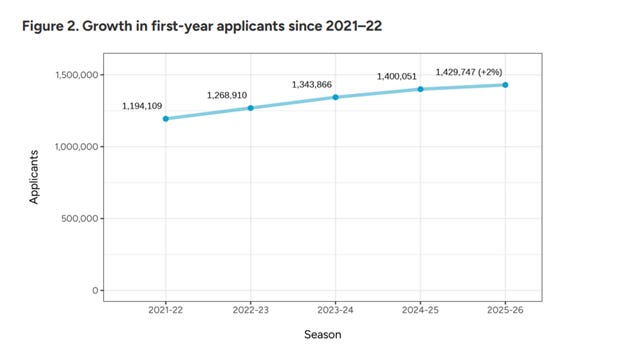
The Common App reported in March that total applications to their 911 public and private members were up 5% relative to the same time in 2025. That said, the number of *students* using the Common App platform to submit at least one application was up only 2%. Keep in mind that the Common App accounts for about 60% of all undergraduate applications nationally, primarily at privates and highly selective public universities – where enrollments have been holding up relative to community colleges and regional publics.
Source: Common App.
Others are arguing that we are already turning out more college graduates than we need, based in part on coming retirements of Baby Boomers who are in jobs that don’t require college degrees. We struggle with the ‘underemployment’ part of that argument – the measures we use to assess underemployment currently are crude at best, and misleading at worst.
Karin Fischer has had nice pieces recently in the Chronicle on the underemployment issue (we are quoted) and the declining college enrollment/too many grads discussion.
Where will enrollment land this fall? That is an open question so we’ll be back on this topic once actual fall enrollment data are in…
Ending Tenure…and Other State-level Policy Developments
We wrote a post in early spring on Governor Kevin Stitt’s Executive Order that killed tenure at all of Oklahoma’s public universities except the University of Oklahoma and Oklahoma State. Going even further than the Executive Order, the Oklahoma state legislature is considering a bill that would extend the ban on tenure to all public universities in the state beginning January 1, 2027. (Oklahoma legislators are still in session at the time of this writing.)
While we don’t find any other pending legislation this legislative season that bans tenure outright, there has been plenty going on in state houses. Kentucky’s legislature passed a bill that would allow public college and university boards to lay off tenured faculty for ‘bona fide financial reasons’ (pretty vague…). While Governor Andy Beshear vetoed the bill, the state legislature overturned the veto.
Alabama also passed legislation making it easier to fire tenured faculty and Tennessee put tenured-faculty terminations in the hands of ‘Provosts and Presidents’ and took faculty out of the termination review process.
Broad-based changes proposed in Iowa, including giving the Iowa Board of Regents the authority to launch post-tenure reviews of faculty at any time and stripping faculty senates of all governance authority (among many other proposals), failed to make it through the Iowa Senate. But, it looks like many of the proposed changes will be picked up and implemented by the Iowa Board of Regents. (Inside Higher Ed provides an informative overview of these and other state-level policy developments.)
In another interesting development, Wisconsin-Madison will be giving 548 faculty in ‘high-demand fields’ raises this summer. The definition of ‘high demand’ is based on the Wisconsin Department of Workforce Development data on “jobs that are projected to have high growth potential, a median salary above the state median, and the most projected annual openings”. (It doesn’t look like ‘economists’ made the ‘high-demand fields’ list. We are outraged, good sirs, outraged!)
$2m was also allocated for “high-demand faculty in areas that advance diversity of thought and the foundation of free markets”. The good news is that the Wisconsin system received its largest boost in state funds in two decades. But, continuing a trend we are seeing across the US, there are more strings attached to those funds
The Value of Humanities Research
Our first podcast was an interview with Dr. Chris Yeoman, Dean of Purdue’s College of Liberal Arts. If you want a tight, well-argued overview of why research in the humanities matters, check it out.
Dean Yeoman’s message and key points are especially relevant given the somber mood 30 Chairs of humanities departments expressed in a recent study from the American Academy of Arts and Sciences.
Reporting out on a series of focus groups held with humanities department Chairs across a variety of sizes and types of colleges and universities, one of the four main findings was “Humanities Chairs believe a massive marketing campaign is needed to sustain their disciplines”. Dean Yeoman certainly laid down the key elements of a compelling case.
Grade Inflation
Professor Kevin Mumford was featured in our second podcast reflecting on his research into grade inflation. Kevin covered some of the key challenges with grade inflation, but also some of the surprising benefits. (Addressing grade inflation was one of the recommendations Yale faculty gave for rebuilding the public’s trust in higher ed. More on that below.)
College Athletics: What’s Going On?
College athletics have been a constant news item this spring. (The Big10 just distributed a record $1.37 billion to its 18 members for the 24-25 fiscal year…to put that in perspective, $1.37 billion would pay four years of in-state tuition for 34,250 Purdue undergrads! Not that we think any of that money is going to pay for anything other than athletics…)
If you want a guide to what is going on and what may be coming, David and his undergraduate RA Becca Caliendo wrote three posts laying out where we are with college athletics: where the money comes from and where it goes, do universities benefit from college sports; and the new legal landscape. If you want more on that legal landscape, check out Substacks from Don Taylor, and Kyle Saunders.
Leading in Academe
We wrote a number of posts on leading in academe this semester. Preparing for a move into administration, leading as a Department Head, getting started successfully as a new Dean and leading as a Dean were all covered. We also did a four-part series on leading more generally in higher ed: managing your time, managing your team, managing information flow, and building trust.
Public Trust in Higher Education
We have written much on public trust and higher education (just not this spring). So, we were very interested in the Report of the Yale Committee on Trust in Higher Education released on April 15. The report ends with a set of 20 recommendations, several of which are most relevant for elite institutions like Yale. (One recommendation: “Grade like we mean it.” See the podcast with Kevin Mumford!)
But, many of the recommendations would apply to any institution including:
Assuming responsibility and ‘being willing to admit where we have been wrong and where we can improve’;
Focusing on the mission and “understanding what we are here for and what universities do best”;
Taking a broad-based view of educational value that extends beyond a future paycheck;
Re-centering the classroom by making “the classroom experience more rigorous and rewarding, with the goal of cultivating sustained attention, intellectual curiosity, and disciplined habits of mind; and
Communicating effectively by “having something to say” and doing more to listen to “Americans across the country – from families worried about college costs to those who feel universities have become disconnected from their values”.
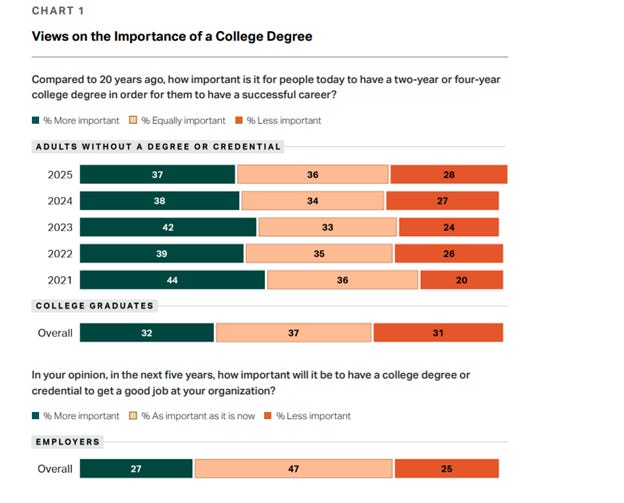
We’ll close with some positive news from the most recent Gallup-Lumina study on adult perceptions of higher education. Some 73% of adults without a degree or credential and 69% of college graduates believe a college education is as important/more important than it was 20 years ago to have a successful career. In addition, 74% of employers said in the next five years it will be as/more important to have a degree or credential to get a good job in their organization.
Source: Gallup/Lumina.
The Yale report and Gallup/Lumina results remind us that while there is still much work for all of us in higher education to do in rebuilding the public trust and in continuing to create value, broadly defined, for society, there is also much to celebrate, to build on.
Perhaps the most vivid demonstration of the good work that faculty, staff and academic leaders have done and are doing will be on display in commencement ceremonies across the nation as our newest cohort of graduates receive their diplomas and take the next step in their professional and personal journey. That is something to celebrate…
What’s Next
We’ll likely post a few things over the summer, but we won’t be on our regular weekly cadence. We will be working on posts for the fall! Our podcasts went over well, so we will also be recording a few more of those. A couple we are considering are scaling experiential education and the role and value of engagement. As always, we can use your help: please send us any ideas for topics you would like to see us address.
We hope you have an enjoyable and productive summer – and thanks for reading Finding Equilibrium!
“Finding Equilibrium” is coauthored by Jay Akridge, Professor of Agricultural Economics, Trustee Chair in Teaching and Learning Excellence, and Provost Emeritus at Purdue University and David Hummels, Distinguished Professor of Economics and Dean Emeritus at the Daniels School of Business at Purdue.
The Fall 2025 NACE survey initially reported a *mean* increase of 1.6% in the number of Spring 2026 graduates firms intended to hire. NACE started reporting medians in their Spring 2026 report and the *median* change in expected new graduate hiring reported in the Fall 2025 report was -2.4%.