


In our last two posts we followed the money on intercollegiate athletics to understand who is paying and what they’re paying for. And we’ve asked whether the large and growing subsidies universities provide to keep their athletic departments growing generate any benefit for the campus.
That analysis covered the last two decades. But in the past few years the landscape of NCAA athletics has undergone a major shift, transitioning from a century of “amateurism” to a model of professionalized revenue sharing. This evolution is driven by a series of landmark legal settlements and ongoing litigation that have effectively stripped the NCAA of its ability to restrict athlete compensation and movement.
In this post we will summarize recent legal settlements, talk about remaining unresolved issues, and highlight the questions these pose for universities.
The House v. NCAA Settlement
The cornerstone of the current system is the House v. NCAA settlement (“House”) which received final judicial approval in June 2025. The settlement had several key elements
1. Back-pay. “House” mandated $2.8 billion in back-pay damages to former athletes. Of this, $1.6 billion will come directly from the NCAA, via insurance and reserves, with the remainder coming in the form of modest reductions in NCAA revenue distributions to member schools. (Roughly $50k-$400k per year per school, depending on size and income; typically less than 0.5% of their overall athletic budgets.)
2. Revenue sharing. “House” enables Division I schools to initially share up to $20.5 million annually in athletic revenue directly with student-athletes. That cap amount is calculated by taking 22% of average earned revenues (not including institutional support or student fees) each year for the Power 4 conferences, and as such is expected to rise to $33 million per school over the next ten years. The cap includes both direct payment to athletes as well as the value of any new scholarships offered under new rules.
3. NIL Regulation. The House settlement created the “College Sports Commission” to vet “Name Image Likeness” deals in excess of $600 using a three-factor test.
Associated Entity Analysis: The CSC determines if the payor is an “associated entity” (e.g., a booster collective, a school’s Multimedia Rights partner, or a donor who has given >$50,000). If the payor is “associated,” the deal faces higher scrutiny.
Valid Business Purpose (VBP): The deal must have a “legitimate commercial rationale.” This means the athlete must perform a specific and current service (a social media post, an appearance, a commercial) that promotes a product or service to the general public for profit.
Fair Market Value (FMV): The CSC compares the payment to a database of similar deals for athletes with comparable “fame or influence.”
If the CSC determines an NIL contract is in violation, athletes can attempt to renegotiate their contracts to be in compliance, or proceed with the contract, but at the risk of losing their eligibility. Schools can be hit with fines and loss of scholarships.
On January 9, 2026 the CSC issued formal notices to 20 Division I schools expressing “serious concerns” over third-party NIL offers being made to football players in the transfer portal. The CSC argued these deals lacked “direct activation” (no specific and current business service) and were clearly recruiting inducements. The CSC has also disallowed deals that use “blanket” language (e.g., “The athlete will provide services as requested by the collective”), and the CSC has cracked down on schools attempting to funnel NIL money through their Multimedia Rights (MMR) partners to bypass reporting.
Altogether, the CSC reports that as of January 1, 2026 it had disallowed 524 deals totaling nearly $15 million, while approving roughly 30 times that number of deals worth $127 million.
Of course, the athletes are not going down without a fight. At least four Power Four athletes have filed for neutral arbitration after the CSC flagged their collective deals as exceeding Fair Market Value. These cases are currently the first test of whether the CSC can legally cap what a private booster is allowed to pay an athlete.
While these changes have upended college athletics, there remain at least three major questions for policymakers and the courts to resolve.
Are “House” Settlement Provisions Consistent with Title IX?
Title IX of the Education Amendments of 1972 prohibits sex-based discrimination in universities that receive federal funds and mandates equality of opportunity for male and female athletes. The House settlement allocates roughly 90% of back-pay to male athletes in football and basketball. In addition, the revenue sharing formulas contemplated by most schools would direct revenues primarily to male athletes on the grounds that their sports are responsible for generating those revenues.
There is a case currently before the Ninth Circuit Court of Appeals challenging the distribution of back payments on Title IX grounds. Until that is resolved, payments sit in escrow. Presumably, legal challenges to revenue sharing will be close behind.
The legal question in dispute is whether back-pay and revenue-sharing payments are effectively NIL financial transactions – a direct fee for service paid to athletes who provide that service – and therefore not subject to Title IX equity considerations. But if courts decide these payments are financial aid to student-athletes, akin to scholarships, then they will fall under Title IX.
The most recent legal ruling in late 2025 allowed the House settlement to go forward on the grounds that it did not require universities to discriminate. But that ruling did not immunize universities from legal fallout should they distribute revenues inequitably and subsequent courts decide these were impermissible under Title IX.
The question for universities then becomes: engage in anticipatory compliance of a potential Title IX ruling, or distribute the funds to attract revenue-generating male athletes?
As an aside, if these revenue sharing payment are not treated as financial aid, they start to look an awful lot like employee compensation. And that raises a whole host of other questions around treating athletes as employees. A short list could include collective bargaining, required public disclosure of benefits, and the potential for lawsuits around: breach of contract or wrongful termination of benefits when someone is cut or not played; worker compensation claims for workplace injury; discriminatory treatment on the basis of protected status…
Economists call situations like these “full employment acts for lawyers”.
Will Congress Provide Anti-trust Exemptions?
The current legal environment features Circuit and District Courts repeatedly throwing out efforts by conferences and the NCAA to regulate payments and athlete transfers. This makes it nearly impossible for the governing bodies of intercollegiate athletics to rein in the worst behaviors on pay-for-play, the transfer portal, or enrolling professional athletes.
There was a howl of protest a few months back when a number of college basketball teams signed ringers (umm, student-athletes) mid-season who had been drafted by the NBA and/or already played professionally here or in Europe.
But what is the NCAA supposed to do? They keep losing in court! Worse, there seems to be a pattern of local magistrates ruling for their home-town teams when an NCAA restriction prevents those teams from recruiting or retaining talent. Which means either no rules, or rules that are effectively different in every jurisdiction.
A possible solution is for Congress to extend anti-trust exemptions for college athletics similar to those provided to professional sports leagues.
Most professional sports leagues constrain the nature of competition between franchises that are, in fact, independent, separately owned and competing private businesses. They allocate talent via a draft, they set hard rules about compensation, they punish owners financially for rule breaking. Were Google and Apple and Microsoft to try and allocate engineering talent in this way, their executives would find themselves facing fines and potential prison sentences.
Professional sports leagues are allowed to do this because a combination of judicial rulings, interpretations by the National Labor Relations Board, and specific Congressional actions provide them with anti-trust exemptions that allow some forms of collusion. The argument for allowing collusion is simple. Unlike software companies, the product professional sports leagues offer is competition itself. And the talent allocation rules they are permitted to employ are designed to create a level playing field for competition and improve the joint product. (The LA Dodgers notwithstanding.)
Congress could step in to provide a framework for permissible collusion. But despite NCAA claims that the transfer portal and NIL payments would be the death of intercollegiate sports, both March Madness and the college football playoffs break viewership and revenue records each year. This makes it harder to argue for exemptions on the basis that the competitive product would be otherwise harmed.
Will Athletics Donations be Treated as Charitable Contributions?
Universities in the US generally hold federal tax-exempt status as public charities which allows them to receive tax-deductible contributions. Donors to intercollegiate athletics benefit from this status in precisely the same manner as donors to the university library or to student scholarships. But should they?
Section 501(c)(3) defines a charitable organization as one that is operated exclusively for religious, charitable, scientific, literary, educational or safety-testing purposes. Charitable organizations must serve public purposes and not benefit private interests. Net earnings cannot benefit private shareholders or individuals, and the organization must operate primarily to further its exempt purpose rather than conducting unrelated business.
Corporate payments to FBS schools total over $4 billion a year. Some coaches are paid more than $10 million a year, and donors are routinely tapped to pay off the exorbitant severance packages when they are fired before guarantees run out. Leading athletes are paid as much as $6 million a year, some directly by the University, and others by donor funds laundered through NIL collectives.
These things are true because college sports are extremely entertaining and entertainment can be monetized effectively. But in what sense is any of that distinct from professional sports, and in what sense is that a charitable enterprise?
To put this more bluntly, all charitable tax-deductions shift the federal burden of taxation away from the person taking the deduction and onto taxpayers at large. Why should a typical taxpayer face a higher tax bill so that very rich people can engage in what is fundamentally consumption behavior – paying to build luxury suites at the stadium and for winning coaches to lead their alma maters?
The IRS has already begun cracking down on NIL collectives, seeing through the sham that these offer some charitable purpose. It would not be surprising to find the rest of the enterprise under similar scrutiny.
These are important questions facing the courts and policymakers. The questions and decisions facing universities may be even larger. Here are four.
How much More Funding will Universities Allocate to Athletics?
Over the last twenty years, FBS athletic programs have benefited from a doubling of donor funds and a near tripling of corporate funds via sponsorships and media rights. They did not use this occasion to limit subsidies to athletic departments, but instead more than doubled those subsidies and tripled direct institutional support.
The House settlement means that schools are allowed but not required to share athletics revenue – many have already opted out, and many others would not be able to afford anywhere near the $20.5 million cap. Keep in mind that the median athletic budget in Division I is only $30 million, and nearly all of these require substantial institutional subsidies to stay in balance.
The average FBS-Division I (top-tier football), schools allocate 11% of athletic revenues to direct financial aid for student-athletes, about $10 million, while the average FCS-Division I budget allocates $3.6 million. Maybe FBS schools will find a way to triple allocations to student-athletes to reach the revenue sharing cap and FCS schools will increase them seven-fold, but we doubt it.
For universities the most important issue is this. Just because you are permitted to reallocate sports revenue to student-athletes doesn’t mean you should reallocate sports revenue. Particularly when the entire enterprise already requires a subsidy that averages 19% of total expenditures for FBS schools and 70% of expenditures for FCS and NFS schools, and that costs other students at the university an average of $1100 a year.
Should Schools Rebalance the Scales between Athletes and Coaches?
NCAA rules previously prevented universities from revenue-sharing with athletes, and so they competed by investing in non-coaching staff, luxe facilities, and paying ever-escalating salaries to football coaches (up 372%) via guaranteed contracts requiring massive severance payments (up 534%).
This presents a choice: spend more money? Or reallocate money away from the categories that have seen the most rapid growth? It’s possible that athletics programs did not need to more than double non-coaching staff, or hire 62% more assistant coaches.
Football coaches’ salaries need not be a ratchet, and the premia paid when unproven assistant coaches ascend to the head job (or move from outside to inside the Power 4) are astonishing. One imagines it would be possible to hire a coach currently earning $400,000 a year as an assistant by, say, doubling their salary. Rather than provide guarantees that pay them twenty times that number over the life of the contract.
How will Schools Handle New Roster Limits?
Historically, the NCAA tried to level the playing field between teams by imposing scholarship limits but allowing unlimited “walk-ons”. Starting with this academic year, schools now face roster limits and the ability to offer every athlete on the roster a full or partial scholarship.
In FBS football, for example, teams could previously offer 85 full scholarships, but now have a roster limit of 105, allowing them to offer another 20 scholarships. For baseball, roster limits could now permit 22 more scholarships; for women, 6 more volleyball scholarships and 13 more softball scholarships (and many, many more than this for swimming, track, lacrosse, and so on).
The immediate impact is that schools could offer (and pay for!) potentially hundreds of additional scholarships. Any net new scholarships count against the $20.5 million revenue cap, but the real constraint is… where is the money coming from to offer these scholarships?
A second impact is that in many sports the hard roster limits will mean a sharp reduction in the number of walk-on positions available to athletes. How important is this effect?
Using EADA data for 2024, we compared pre-“House” roster sizes to roster limits to determine how many teams in each sport were over the new roster limits and how many athletes would be affected. We highlight the ten biggest “offenders” in the table below.
Nearly all track teams are well over the roster limits; 87% of football, 94% of baseball and more than 70% of men’s and women’s soccer teams are over the limits. Across all sports, more than half of teams exceed the new roster limits. Coming into compliance will mean releasing almost one-quarter of the athletes currently competing in Division I.1
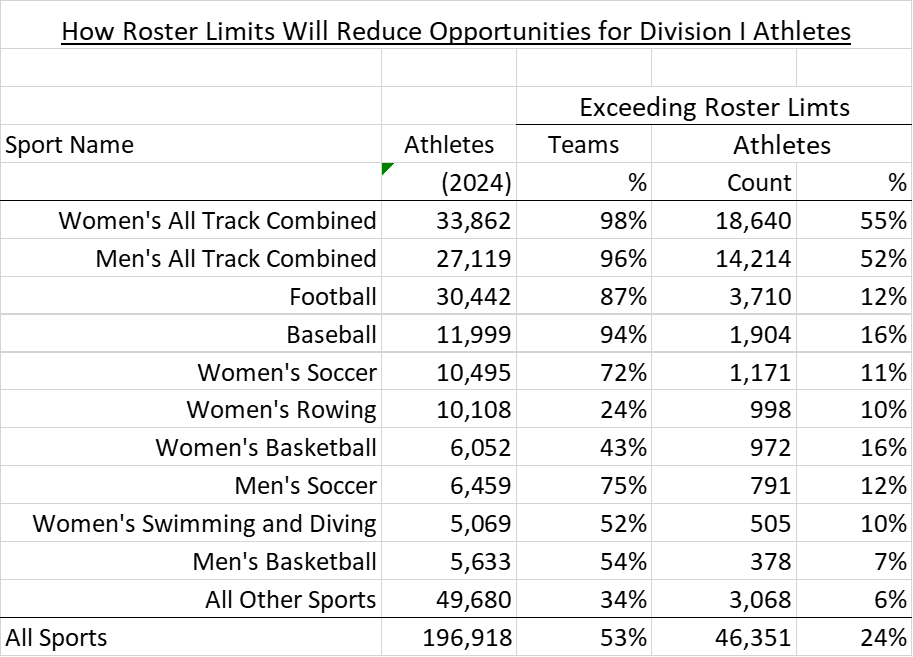
Source: Author calculations using Gemini based on EADA data
Is there any benefit to being a rostered athlete who is not on scholarship? Yes. These athletes have the opportunity to train with professional coaches and compete, receive travel expenses for competition, free food at the training table, and free academic support and tutoring. Some receive bonus “Alston” payments for academic success.
(Full disclosure: Becca Caliendo, one of this post’s coauthors, competed as a non-scholarship track & field athlete for Purdue, a sport that will be hardest hit by mandated roster cuts moving forward. Her time as a scholar-athlete was well-spent. She graduated in Spring 2025 with a 3.99 GPA, was the Senior of the Year in Purdue’s Economics Department, and is finishing a MS in Global Supply Chain Management before beginning law school at Northwestern next year.)
One interesting possibility is that given the roster limits, many more athletes look to Division II, III, and NAIA schools to continue competing. The sports particularly affected by the roster cuts also correspond to some of the most popular high school sports, and there will be a lot of athletes looking for a home. As we showed in the first post, these divisions have absorbed a very significant increase in student-athlete enrollments – and might welcome an enrollment windfall.
This would require these lower tier schools to either create new teams or to expand rosters on existing teams. And to do it in those sports where Division I schools are forced to release the most athletes.
The trouble is, the vast majority of Division II, III and NAIA schools already have teams in almost all of the sports listed in the table above, and rosters whose average size is larger than the Division I roster limits. (They would not face regulatory limits on roster size, but they would struggle to find space for more athletes to compete.) The main exceptions to this are football, presumably the most expensive sport to operate; women’s rowing, which requires a significant body of water; and men’s and women’s track.
The upshot of all that: absent a major expansion of football or possibly track, it seems most likely that the new roster limits will simply displace a significant number of athletes from competing at all. Athletes who don’t find space at the Division I level will either give up on intercollegiate sports, or move down a division and displace the athletes there.
4. What About the Impact on the Typical Student-athlete?
While the courts and much of the popular discussion of the “House” settlement emphasizes its benefits for athletes, we think the new rules and environment have the potential to actually worsen conditions for the typical student-athlete. Let’s explain why.
In our last post we described data showing that intercollegiate athletics participation provides better access to college, higher retention and graduation rates, and better employment prospects. But that data was drawn from a time when strict NCAA regulations limited transfers, before roster limits, and before continent-spanning mega-conferences turned game travel into a full-time job. Things have changed.
First, as we just described, many Division I athletes will be jettisoned and lose their associated benefits.
Second, we think unlimited transfers and expanded conferences will hurt academic performance and graduation. Nearly 11,000 football players entered the portal by mid-January 2026, including almost a quarter of the players from FBS and FCS schools. Many of these students are transferring for a second or third time.
We don’t yet know what the transfer portal will mean for graduation statistics, but we can guess. We do know that it can be hard to transfer course credits between institutions. Athletes repeatedly entering the transfer portal will struggle to accumulate the credits, or achieve the learning necessary, to complete a degree.
We also don’t yet know what all the game travel does to athletes’ performance as students. Mick Cronin is extremely irritating and a constant whiner as the head coach of UCLA’s men’s basketball team. Nevertheless, he is spot on in his repeated criticism of his team’s impossible travel schedule now that they’ve joined the expanded Big 10.
Cronin is worried about on-court performance, and he should be. An extensive literature demonstrates that sleep loss and disrupted circadian rhythms lead to significant loss in coordination, reaction times, and cognitive function. But how do we expect athletes to perform as students when they are missing dozens of class days and dealing with significant cognitive impairment from sleep loss and jet lag the rest of the time?
Universities and the NCAA need to provide transparency on the impact of the new rules on academic performance in-season, graduation, and placement rates.
But They’re Getting Paid, Right?
Yes, and some of them are getting paid a lot! If you are Arch Manning pulling $6 million a year in NIL deals before being drafted into the NFL and making many multiples of that, this brave new world is terrific. But what about the typical athlete?
Let’s assume that schools provide all $20.5 million in revenue sharing. This seems extremely unlikely to us, particularly for smaller schools. But let’s just run with that number, and you can scale down all the numbers that follow if revenue-sharing winds up much smaller.
SEC schools rostered around 500 athletes, Big10 schools between 500 and 1000 before roster limits. If we spread $20.5 million in revenue sharing evenly over 500 students, you get $40,000 each. Pretty good!
But that won’t happen. Instead, it appears many schools are using a revenue sharing plan that mimics the back-pay distribution model, with 90% of the revenue flowing to 120 men’s football and basketball players, 5% flowing to 15 women’s basketball players, and the remaining 5% flowing to the other athletes.
For the non-revenue sports $1 million split over the remaining 365 athletes amounts to…$2740 each. Not exactly a windfall. For the 120 men’s football and basketball players, they’ll split 90% of the pot ($18 million). If spread evenly, that averages out to $600,000 over four years. That is serious money!
But schools also won’t spread this equally among those 120, especially when the “going price” for a starting QB in the transfer portal is around $2 million, with some making twice that. If one guy is getting 10-20% of the total, and other prominent offensive positions are getting high six-figure deals, you know the backup fullback isn’t getting much beyond a scholarship.
We’d guess that the athletes getting the most are probably the ones most likely to have a big payday waiting in the pros.
The vast majority (about 99%) of these student-athletes won’t play professionally, and most of them will get relatively meager amounts of revenue sharing. And because of the rule changes, and the travel in these mega-conferences, we would predict that more of them will not finish their degrees.
Recent college grads earn about $32,000 a year more than high school grads and the gap grows with experience. The most recent estimates indicate that a college degree is worth an extra $1.2 million over a working lifetime, and much more than that for those who go onto graduate or professional study. So reducing the number of athletes who graduate is a big deal.
The new rules are a windfall for a small handful of elite and soon-to-be professional athletes. That is because the rules recognize the market earning potential of those few athletes and, pending resolution of Title IX and other legal considerations, don’t require that earning to be transferred either to coaches or to non-revenue sport athletes. One might even regard that as a just outcome.
But it does require the university to ask, what larger set of values caused us to run a broad multi-sport athletics department in the first place? And what impact do choices made to maximize football and basketball revenue have on all the other athletes?
Where Does this Leave College Sports and the University?
There is a natural tendency to answer this question by focusing on what happens on the field. No doubt a world with few financial and legal constraints will lead to a concentration of power in the richest conferences and in those schools with the most rabid and well-heeled alumni bases.
There will still be Cinderella stories and improbable runs, maybe just a bit less likely. People, evidently, will continue to tune in even as the roster of their favorite team turns over completely each year. They will, as the Seinfeld bit goes, cheer for clothing. We’ll keep showing up in Mackey Arena, hoping Braden Smith breaks the all-time assist record, or that this is the year we hang a banner.
The more interesting questions relate to what it means for the university and its students. We pose some here – without answers – for your consideration.
At what point will legislators, so focused on rising costs of education and keen to micromanage university affairs on other matters, start to ask: why are millions of dollars in university subsidies flowing to the athletics department?
Will students and their families ask: why are we paying higher tuition and fees to subsidize a professionalized college sports program when all we want is an education?
Will the universities themselves, increasingly willing to cut faculty and staff when majors don’t meet enrollment targets, start to ask: why are we spending millions to host athletic competitions for which there are almost no paid spectators?
Will they ask: is a system that enriches elite and soon-to-be-professional athletes at the expense of the rest of the student-athletes really what we want to promote?
Will they ask: are we really comfortable with the rising influence of athletic donors, donor collectives, and now potentially private equity on the business, not just of athletics, but inevitably the entire university?
Will someone, anyone, ask the question that Robert Hutchins asked at the University of Chicago 90 years ago: is any of this consistent with the mission of a great University?
Next Week
We return to academic leadership - and to those thinking about an academic leadership position. How can you decide if you might like administration? How can you prepare for a leadership position? We’ll offer our thoughts next week in Finding Equilibrium.
Thanks to Nayfa Johan for research assistance on this and earlier athletics posts.
“Finding Equilibrium” is coauthored by Jay Akridge, Professor of Agricultural Economics, Trustee Chair in Teaching and Learning Excellence, and Provost Emeritus at Purdue University and David Hummels, Distinguished Professor of Economics and Dean Emeritus at the Daniels School of Business at Purdue.
A caveat here. It might be that some athletes are dual-rostered, e.g. both in football and in track. In this case roster limits might stop dual-rostering and disallow competing in a second sport, but not cause the athlete in question to lose opportunities to participate in their primary sport.
This has been an interesting and excellent series, and one that only becomes more important as private equity is now looking at university athletics as an investment domain, which I'd assume will bring significant pressures to bear on such departments and will force the issue of what they are and what is their relationship to the university? They are at some level operating as minor leagues for major sports leagues, but their revenue and pay structure is very much not comparable to those of actual professional minor league teams, because they get to free-ride off the branding of universities.
Worth noting that this week saw the NCAA settling another case they were likely to lose, Brantmeier v. NCAA. This one was related to the prohibition/limits on college athletes accepting prize money from professional events. Details of the settlement are TBD, but it'll be relevant in college sports where there are individual opportunities for outside pro competition. I'm a fan of college tennis, and the Purdue coaches do great work in emphasizing team values, but increasingly they are at a disadvantage against teams who recruit mercenary players who have been on the pro tour (23-26 year old "freshmen"). But, even worse, we also see coaches allowing their best players to skip out on team events to play pro events - #4 ranked LSU women's tennis recently lost a conference match to Ole Miss when their top two players went off to play a pro event in Mexico. Some players are obviously being recruited / paid NIL money with the goal of helping the team win a national championship in April/May, and are being allowed to do what they want until then.
The details of the Brantmeier settlement will be hugely important as to whether this pattern will accelerate, and whether it threatens the very existence of such sports at the D1 level.
Great piece. I was wondering about how these new rulings would be integrated into higher education. And maybe this -
From ESPN
The most common way to pay for stadium improvements is the issuance of tax-exempt bonds.
From Google
Tax-exempt bonds—particularly qualified 501(c)(3) bonds—are strictly prohibited from allowing net earnings to inure to the benefit of any private shareholder or individual.
I wonder if investors in tax-exempt bonds that financed university stadiums might be paying a lot of federal taxes soon on stadium bonds.