
Do Universities Actually Benefit from College Sports?
Universities and Athletics: Part 2


In our last post we summarized the changing financial and enrollment picture for intercollegiate athletics. Outside of Division I, student-athletes are a significant and rising share of overall undergraduate enrollment. Inside of Division I, intercollegiate athletics has exploded financially. New corporate revenue sources and rapidly rising institutional subsidies have translated into runaway spending across the board, but particularly fast increases in facilities expenditures and coaching salaries and severance payments.
The institutional subsidies are profound. Even as revenues from corporate licensing and broadcast rights have tripled in inflation-adjusted terms, universities have not used their occasion to balance the books or lower the taxes they impose on other students or university activity writ large. No, they have more than doubled their subsidies of athletics departments. These subsidies constitute nearly 20% of athletic budgets in the top-tier (FBS) Division I schools, and 70% or more of athletic budgets elsewhere.
Why? Is this simply an arms race driven by a devotion to winning and securing bragging rights in a zero sum environment? Or does all that spending generate tangible benefits for universities?
Let’s leave aside the psychic anguish fans face when their in-state rivals win head-to-head. Or, God forbid, win a national championship! We’ll consider five tangible benefits: benefits to athletes themselves; shaping the campus population; alumni affinity; sports as “earned media”; and the amenity value of athletics and its measurable impacts on student applications and enrollment.
We’ll try to be careful about magnitudes. It’s not enough that a benefit exists. For each we will consider whether the magnitude of the benefits is commensurate with the costs of providing them.
Benefits to Athletes
Participation in intercollegiate athletics generates positive outcomes for the athletes themselves. While there is a long literature studying these impacts, the best evidence comes from a recent comprehensive study by Nobel laureate James Heckman, Colleen Loughlin, and Haihan Tian. They draw on two nationally representative longitudinal surveys that begin in 1988 and 2002 and track students for a decade. They join these to confidential data from the NCAA on participation in Division I and FBS athletics participation.
Heckman and colleagues compared outcomes for athletes to similar non-athletes. (Similar means: matched on student cognitive ability and household characteristics such as income, single parent status, and ethnicity.) They found strong evidence for the benefits of scholastic athletics at all levels.
Participation in high school athletics is associated with a higher probability of graduating from high school (5.5%) and of attending college (12%).
Athletes are 40% more likely to get into their first-choice college and, conditional on receiving admission, 33% more likely to receive scholarships or grants.
Intercollegiate athletes are more likely to earn a degree (9%), and earn higher (6-10%) starting wages. These effects are more pronounced in larger (FBS) athletics departments.
The collegiate effects are plausibly linked to the financial benefits of an athletic scholarship (financial exigency is a key predictor of college non-completion), to the academic commitment and monitoring imposed by athletics departments (mandatory study halls, midterm grade checks), and to direct investment in academic tutors.
The high school effects are plausibly linked to the motivational effects of wanting to stay academically eligible to compete, and to the hope of acquiring a college athletic scholarship. We can then think of college athletics as delivering both direct benefits for participants, as well as a spur to excellence for aspiring high school athletes.
Still, one should interpret this somewhat cautiously. First, there were also sizeable benefits in completion and earnings for students who participated in intramural college athletics. Second, while these effect sizes are quite large, they are expensive to purchase. Recall that the average Division 1 athletic department spends $109k per athlete per year, with a direct institutional subsidy of $22k per athlete per year.
We don’t have the counterfactual that asks: what happens to completion and earnings if we devoted a similar level of investment and attention to a non-athletes? Our guess is that the outcomes would be at least as good.
Shaping the Campus Population
In the Heckman et al study, the benefits of athletic participation – especially high school completion and earnings after college – are particularly pronounced for minority and economically disadvantaged populations. This means that athletics provides a vehicle for social mobility. But they also provide a means of shaping the campus population that becomes particularly relevant in an environment where the Supreme Court has ruled race-based affirmative action illegal and the Trump Education Department has declared war on anything with a whiff of DEI.
In all Division I sports, 20% of athletes are Black, but these numbers are much higher for revenue sports (44% for men’s basketball and 40% for football). These shares are ten times higher than the 2-4% share of Black students in overall university enrollment. Graduation rates are also much higher for Black athletes than for Black non-athletes, meaning athletics also increases the representation of Black students among university graduates.
Shaping the campus population is not only limited to underrepresented ethnic minorities. The male share of the undergraduate population has been steadily falling and now sits at around 40% nationwide. Heckman et al found that athletics increases high school graduation and college attendance probabilities more for men than for women.
The remaking of the New School in Florida under Governor DeSantis provides a prime example of how this could work. New School Trustees had bemoaned the low male attendance rates and linked them to needed cultural changes. Between Fall 2022 and Fall 2025, the male share of enrollment rose at New School from 32 to 46%. To accomplish this, the New School started athletics programs for the first time, and committed a large share of its scholarship base to athletes. Famously, enough men’s baseball players were admitted to field 8 starting squads, and comprised 21% of the incoming class.
Courts can easily check SAT scores to see if a demographic group is receiving disproportionate favor in admissions. But they can’t evaluate whether all 8 shortstops the New School admitted can turn a double play. Athletics provides a free pass for admitting whatever student demographic you would like.
Athletics has also been a ticket to boosting enrollment in the face of intense competition for students. We can see this in Division III and NAIA schools, where student-athletes now represent 28 and 40 percent of the total undergraduate populations. As an example, Adrian College in Michigan has added 30 sports since 2005, and doubled their enrollment.
Division III schools do not offer athletics scholarships and NAIA schools offer only partial scholarships subject to caps. While they do have athletics department expenditures ($8k per athlete for Division III, $15K per athlete for NAIA), these expenditures can be thought of as standard tuition discounts. On a campus with excess capacity, an additional student paying half-price is far better than no student at all.
This works because athletics participation is tightly bound up in the identity of high school athletes. In the 2023-24 school year, over 8 million students competed in high school sports. Many of them have trained upwards of 15 hours a week; some have trained for a full decade in intensive club and travel sports. Collegiate athletic participation is a point of pride for the student (and especially the parents who shuttled them to endless practices and spent large sums on travel, equipment, and extra coaching). It also represents a continued opportunity for focused and intense physical training, and the development of discipline, communication and leadership skills.
However, its possible that this strategy may have run its course. It has clearly not worked for some schools. And as we detail in our third post, the vast majority of NCAA Division III and NAIA schools have already created oversized rosters in nearly every sport with low entry costs and large numbers of high school athletes.
Alumni Affinity
Universities want to retain and build alumni affinity for the university. Affinity translates to alumni giving back: as mentors and employers of students, as industry experts to faculty and leadership, as donors who fund key initiatives. The question is, how precisely does one nurture that affinity?
Glossy brochures get trashed. Emails wind up in spam filters or cause recipients to mash the “unsubscribe” button. Nobody wants an unsolicited phone call.
In the face of information overload, athletics provides a welcome opportunity for alumni to reconnect to the university. To watch a game with old classmates, or exchange texts about the recent victory. To travel to fun locations for bowl games and tournaments or to return to campus after many years away. Some of that reconnection is about the game itself; a lot is the reminder of just how great it was to be 18 years old and in a place that shaped the person you became.
So a strong link between athletics and donor affinity seems plausible. And as former (highly successful) fundraisers, Jay and David can say that many conversations with high-end donors were organized around athletics. Further, if we look back at the USA Today athletics financial data that we discussed last week, there is a strong correlation between the size (revenue) of the athletics department and the share of donor contributions in overall athletics revenues.
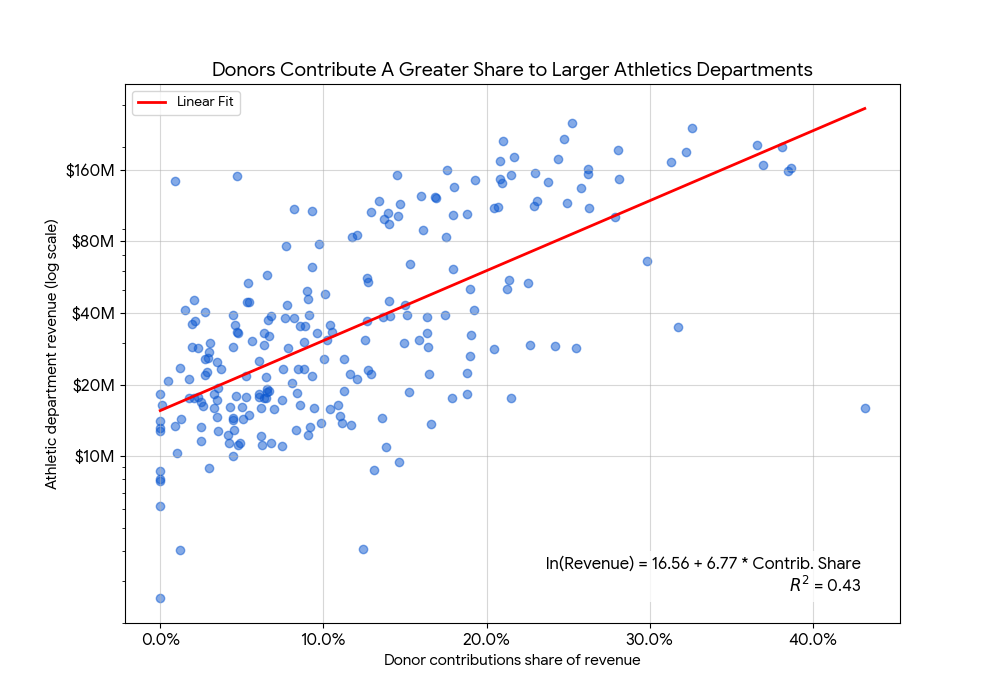
Source: Authors calculations with Gemini code, based on USA Today Data.
The direction of causation here is unclear. More to the point, the chart above tracks donors giving directly to the athletic department itself and presumably this effect is strengthened by athletic success. But the impact that athletic success has on donations to the rest of the university is unclear. It could easily be negative if athletic success and subsequent giving to athletics crowds out giving to academic units. That becomes especially relevant now that wealthy donors are tapped to provide NIL payments directly to student-athletes.
The highest quality recent evidence we found showed unexpected wins translate to additional athletic donations but not to donations outside the athletic department, or to the number of donors who give.
Earned Media
What about sports broadcast viewers other than alumni and donors? In other contexts, we have made the argument that the university needs to do a much better job of telling its story to both politicians and the public at large.
Apart from the brand recognition of having the university name and logo on screens for hours each week, sports broadcasts afford universities an opportunity to provide advertisements of their most noble work. You’ve no doubt seen carefully crafted ads that universities place during commercial breaks. They sell the public on the value of the university, the students it educates, the breakthrough research it produces, their service to the state and their stakeholders. This may be the single best opportunity to make the case for the university to most of the public.
Marketing types call it “earned media” when a notable thing a university has done receives news coverage without explicitly paying for air time. That air time gets valued in advertising equivalent dollars: what would you have paid to run a commercial?
For the few teams strong enough to break through into prime-time national television broadcasts, this generates enormous “earned media” value. Some estimates put the price of a 30 second commercial in the recent FBS college football championship at $2 million. Playing in the game itself constitutes 3-4 HOURS of brand exposure even before counting all the coverage before and after.
Simply making it to prime time on ESPN during the regular season is a big deal, with ad rates reaching as high as $150,000 a minute. And presumably, the exploding value of media rights packages for Big 10 and SEC teams at over a billion dollars a year reflects what networks can charge for ads.
However, most teams are either not broadcast at all, or appear only on radio (ad costs in the hundreds of dollars), or are seen on local TV networks (ad costs in the low thousands of dollars). Paying tens of millions in athletics subsidies is an expensive way to get that coverage.
But ultimately, “earned media” exposure is only really valuable if it translates to something that the university wants. Like, for example, students.
Applications and Enrollment
Going to college is fun. Going to football and basketball games in a raucous venue with your friends, possibly after some aggressive tailgating, is a lot of fun for many students. We certainly enjoyed it (and still do)!
Creating those opportunities shapes the amenity value of the campus and may help attract applications and enrollment. One hint at this effect is the increasing concentration of enrollment in the largest comprehensive universities and the shrinking of smaller and less-selective universities. Enrollment at powerhouse SEC schools have been increasing markedly, though its unclear whether this is football, sunshine, or the insidious effects of #RushTok.
Not surprisingly, researchers have explored whether athletic success translates into applications and enrollments. The challenge to identifying this effect is that good universities have strong academics and strong athletics and many other amenities (massive rec centers, extensive Greek life, the lure of scale to bring in many corporate recruiters). It’s hard to know which of these attract students.
The most compelling evidence comes from instances where a team was a surprise winner or a surprise champion. The surprise element is critical because it represents a sudden spike in visibility for the university relative to slow moving trends in university quality, and that spike is directly attributable to the outcome of a game.
Scholars call this the “Flutie Effect”. During a 1984 nationally televised game against the defending national champion Miami Hurricanes, Boston College quarterback Doug Flutie completed a 48-yard “Hail Mary” as time expired to secure a huge upset victory. In the two years following that play, undergraduate applications to Boston College increased 30%.
Closer to home, back-to-back NCAA Final Four appearances by Butler University in 2010 and 2011 created a huge boost in visibility. Applications rose 41% in the first year, and by 2018 they peaked at 163% above 2009 levels. Because the pool of applicants grew so much faster than the school’s capacity, Butler became significantly more selective, and shifted from a regional school to one in which 60% of the incoming class arrives from out-of-state. Annual fundraising totals nearly doubled.
These examples are buttressed by several careful econometric analyses that focus on surprise wins and championships, and that find qualitatively similar effects. (We assume someone will study the “Flutie Effect” for our neighbor to the south after their recent national football championship…)
This seems like strong evidence but there are two problems. The first is that surprise wins themselves may attract initial visibility. But sustained success requires concentrated marketing and programmatic effort and expenditure to exploit the opportunity.
The second is the “surprise” nature of the wins under examination and the fact that athletic competition is zero sum. Surprises, almost by definition, cannot be planned for. And for each surprise winner there was a surprise loser (or more than one). Spending more money doesn’t necessarily translate to sports success, particularly in an arms race where all your conference competitors are doing the same.
Unexamined in this literature is the question: could the university have had similar impact if it simply engaged in aggressive and targeted marketing to attract students? When we started professional marketing campaigns for our undergraduate business degrees at Purdue we saw interest and applications rise as fast as Boston college and Butler after their “Flutie Effects”. But we spent an amount equal to about 0.1% of Purdue’s athletics budget doing it.
In Summary
The largest Division I universities spend over $14 billion a year on intercollegiate athletics, at least $3.5 billion of which comes from other students and the rest of the university via institutional subsidies. Is it worth it?
Athletic spending creates benefits for the athletes themselves, but presumably one could generate similar or better outcomes for a larger number of students and more cheaply with direct spending on student success.
Admitting student athletes gives universities a way to shape the campus population in ways that are otherwise prohibited by recent legal decisions.
Sports teams generate alumni affinity, and broader visibility. For the most successful and high-profile teams the associated “earned media” value swamps athletic spending. But earned media is only really valuable if it generates something else of benefit.
Athletic success does not seem to translate to greater donor giving to the rest of the university outside of athletics. It may, especially in the case of surprise wins, generate growth in applications and enrollments. But it’s hard to plan for surprises and professional and targeted marketing is much cheaper.
With all these claims, the experience of specific universities may differ substantially from average effects. Lower tier institutions provide much larger subsidies both relative to the total athletic budget and to the overall budget of the university. The benefit hurdle they need to meet is correspondingly higher. They are also far less likely to get the outsized “earned media” exposure that comes with games televised in prime time.
The key question is whether athletics is an amenity that draws students to campus. In the case of Division III and NAIA schools, the strategy is recruiting students *as* athletes, and they represent 28 and 40 percent of those student bodies. Less clear is whether enough non-athlete students care about spectating at intercollegiate athletics to make a difference in enrollments outside of surprise wins and powerhouse conferences.
In our next post we will tackle the changing legal landscape of intercollegiate athletics and the questions it poses for universities.
Thanks for Sue Doron for helpful insights and data on the Flutie Effect. Thanks to Nayfa Johan for research assistance and data work.
“Finding Equilibrium” is coauthored by Jay Akridge, Professor of Agricultural Economics, Trustee Chair in Teaching and Learning Excellence, and Provost Emeritus at Purdue University and David Hummels, Distinguished Professor of Economics and Dean Emeritus at the Daniels School of Business at Purdue.
 |
|
An excellent review of a contemporary issue! Your data points are especially relevant and helpful. I do think you might have underestimated the positive impact of a winning athletic program on the attractiveness to potential students. People want to associate with winners.
Nice work. I’ve shared this with several friends, and one son who recently left his position as a D1 football coach/coordinator over concerns of the impact from professionaled college sports.
I appreciate the willingness to question college athletics objectively!
I really think D1 basketball and football are just minor-league professional sports at this point, with little to do with the university apart from essentially age criteria. I wonder if they really should just be cleaved off from the universities entirely.
Lafayette Boilermakers vs. Storrs Huskies. (...okay, I can't say that has much of a ring to it, but it could grow on me.)
---
Regarding student success correlations, I have to imagine it partially has to do with kids who participate in sports just being well off generally, and I'm not sure if you called that out. Surely, parents who have the means to send their kids to club sports practices are more prepared to send their kids to college.