


US universities spend about $108 billion a year on research, of which 60% is supported by federal, state, and local governments. Another 25% of this spending comes from institutional resources, which translates to money that could have been spent on instruction, or engagement, or non-research infrastructure, or the football team…
How do universities justify that investment? To be clear, we (David and Jay) love research! We think it is extremely valuable to society and a core mission of higher education. Many of our readers probably feel the same way. But OF COURSE we think that. We are socialized in our profession to think that.
Faculty in tenured or tenure-track positions are part of this big tournament where research both decides who wins and is itself the prize. Better research leads to promotion, but also reputation, invitations to travel and speak, funding and awards, better grad students and post docs, and more time devoted to doing the research we love and believe is important. So, of course we think it’s valuable!
The question is…how do we convince the public that university research is valuable? Especially when they are increasingly distrustful of what we research, or the rigor and integrity of that research, or when the fruits of that research have been painted (unfairly in most cases) as politicized.
Direct Tangible Evidence: Business and Philanthropy
It is common for universities to point to record-breaking research funding numbers as a stand-in for the success of their research enterprise. And given the intense competition for grant funds, impressive research funding certainly indicates that faculty and their work are held in esteem by peer reviewers. But funding is an input, not an output, and it is zero sum – if government agencies allocate $60 billion in research funding, someone is going to get it.
What evidence shows that our research output has tangible *external* value?
The most obvious case can be made for the 14.7% of university research funding that comes from business ($6.2 billion in 2023) and philanthropic sources ($9.8 billion in 2023). Business can invest anywhere it wants, including internal R&D or R&D conducted by partnering firms. To invest $6.2 billion in university research, it must be that business values the university research it commissions by *at least* that amount.
Modern philanthropies care about societal problems rather than profits. But they are shrewd judges of investment choices and the competition for their resources is tough. They invest in university research because they believe it has the best chance of solving problems of interest.
What about Government- and Internally-funded Research?
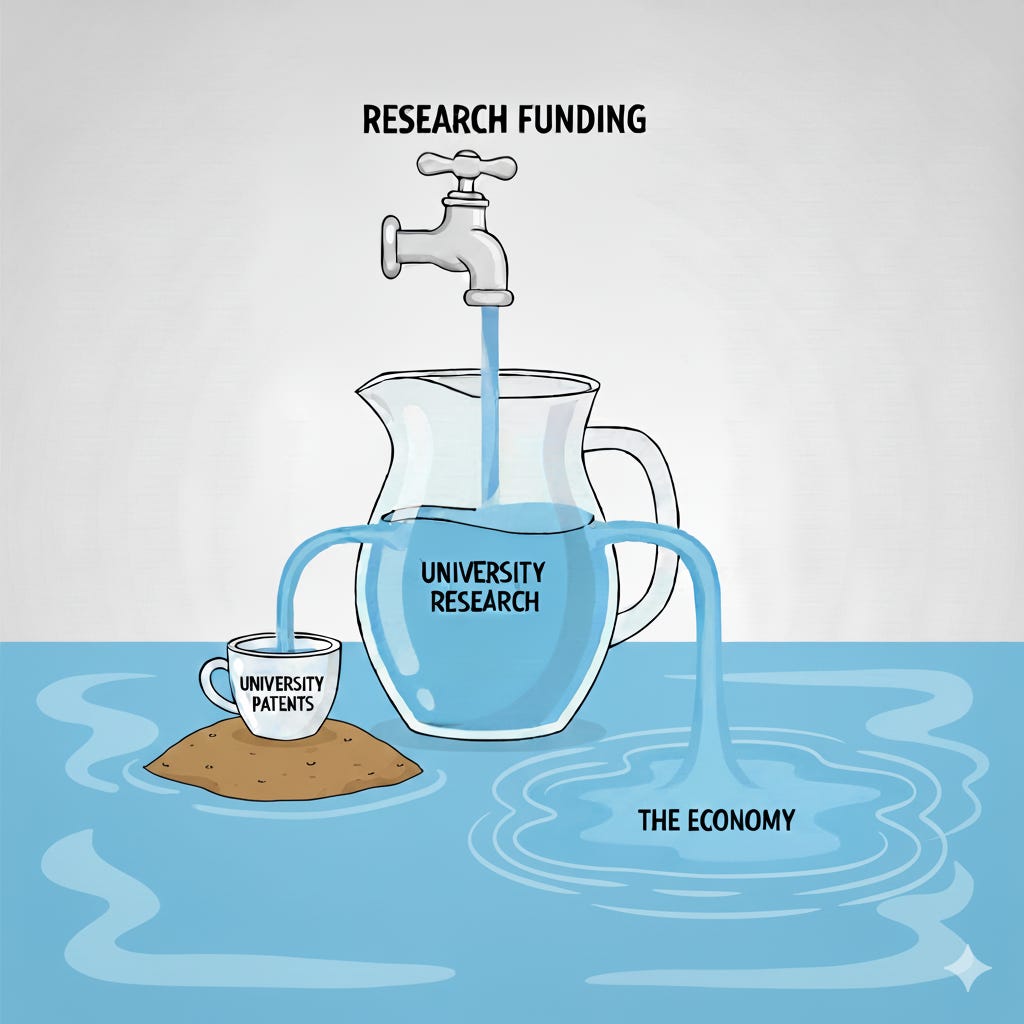
Universities increasingly point to patents, license revenues, and start-ups spun out of faculty research as tangible evidence that university science is “real”. But if you look hard at the numbers, these just aren’t big enough to justify the research enterprise on their own terms.
University research spending comprises about 12% of overall R&D spending in the US, but associated commercial activity is a much lower percentage of overall US activity. Universities generated only about 2 percent of the total patents granted nationwide in 2024, and a similar or lower number in previous years. Universities generated 19,000 startup businesses between 1996 and 2020, or about 760 each year. That is in contrast to the 200,000 to 250,000 businesses started nationwide each year in that period.
The licensing fees that universities generate from these patents and spin-offs are small relative to the amount invested in the research enterprise. This is true even in powerhouse STEM universities like Johns Hopkins or Stanford or Purdue.
Of course, if commercialization dollars are the preferred metric, it only takes one success to make the whole thing worthwhile. Famously, the University of Wisconsin’s research foundation WARF grew rich because university researchers were able to identify an anticoagulant factor from spoiled clover that killed a cow. That initially became a hugely successful rat poison, then found human application as the widely-prescribed drug Warfarin, which is used to treat vascular and heart disease and prevent stroke.
Still, that is literally a one-in-a thousand shot. The vast majority of research output in universities never leads directly to a successful rat poison, let alone something that benefits millions of patients around the world with heart disease or strokes.
That’s not unique to university science – it is the way science works. As we’ve detailed before, corporate efforts at innovation are often failures. And even wildly successful innovations typically involve repeated failures before finding something that works – think of Edison testing 1500 different materials for the filament in his incandescent light bulbs before finding one that worked.
There are really interesting reasons that university science rarely translates directly to commercial successes like Warfarin but offers great value to society nonetheless. We’ll talk about three. One, what happens in the innovation pipeline between basic science and commercial applications. Two, idea spillovers. Three, research that generates social and economic value that cannot be commercialized.
Supply Push and Demand Pull in The Innovation Pipeline
There is a fascinating emerging literature on technological innovation and its drivers. If you have some time, we recommend Brian Arthur’s book, The Nature of Technology.
When we unpack drivers of innovation, we can think about two critical forces: “science push” versus “demand pull”. “Science push” means that some innovations arise from a deeper fundamental understanding of the physical or human world. Centuries ago, that meant grappling with basic principles of chemistry, physics, biology, mathematics, economics and so on. Today it means ever more sophisticated understanding of these principles, as well as new areas such as gene editing, quantum science, or neural networks.
When we understand new fundamental properties we sometimes (sometimes!) see a path to building those properties into specific products or services that people will value. In earlier times, fundamental properties became electric power (and all its applications), or improved plants and animals, or synthetic rubber, or mechanical and then electrical computers. Today it is things like generative AI, or quantum computers, MRNA vaccines, or GLP-1 drugs.
But for the most part, what happens in universities is science for its own sake. Deepening our understanding of the physical and human worlds is the end goal, and worthy, regardless of whether some specific understanding makes its way into some particular consumable outcome. That means that a lot of what we produce as researchers will never directly make it into commercial use because the science is driven primarily by the individual curiosity and insights of the researcher. Of course, perspectives on what is important and worthwhile are also shaped by gatekeepers in the field: funders, editors, and %&*$!! “referee number two”.
The other major force is “demand pull”. There is a potentially valuable product or service we know we want to create, but we just don’t know how to make it. Or we have some significant societal problem like climate change or food insecurity we want to solve. And so the incipient demand for that product or service or solution pulls the necessary science toward a specific goal. In some sense, it goes searching for a basic principle or understanding that will make a specific problem solvable.
Improving the Mismatch Between Scientific Supply and Demand
Getting these two forces to match up is hard. After all, what are the chances that some specific slice of biochemistry or material science that happens to inflame the intellectual passion of a dedicated researcher will also correspond to the very specific slice of biochemistry or material science that is needed to solve a firm’s specific innovation problem?
Mismatched scientific supply and demand is worsened by three key factors.
One, very few products or services are the result of a specific and individual piece of science. Almost all technologies are complex combinations of other technologies, rooted in different pieces of underlying science. Think about your smart phone: how many discrete parts and distinct technologies does it embed, and what physical properties of the universe or human properties of cognition and attention were needed in combination to design and produce it. Hundreds? Thousands? More? (In 2024 alone, Samsung filed 9304 patents, more than all US universities combined…)
Many products seem less complex than a smart phone because they are not composed of thousands of discrete parts and technologies, and yet they still embody layers of evolving scientific understanding. The unbelievably rapid deployment of the COVID vaccine was possible because of a century of accumulated research. The vaccine incorporated many basic discoveries about viruses in general and coronaviruses in particular, tools like electron microscopes that were necessary to actually see and study viruses, gene editing tools, the function of mRNA, the ability to encapsulate mRNA in lipid nanoparticles, and of course, all the management techniques needed to integrate a complex supply chain of nearly 100 specialized production facilities worldwide that worked to produce the vaccine and its components.
Two, and as illustrated by the COVID vaccine, there are long lags between when science is originally produced and when it has commercial effect, around 20 years on average. Forget commercialization, even recognition that a particular piece of science is good and important can take a long time. In the early 20th century, Nobel prizes were awarded for research that was 10-15 years old. In the early 21st century, Nobel prizes are awarded for research that is 20-25 years old.
Three, universities are ill-suited to handle the regulatory burden that comes with efforts to commercialize innovation, particularly in the life sciences. New medical devices take 3-7 years to secure approval, new drugs 12 years, with some estimates of the associated costs of drug approval running into the billions of dollars.
Despite these challenges, there are concerted efforts to connect “science push” and “demand pull” and improve the commercial potential of university science. Here are a few.
Federal funding agencies identify priority areas for research through conversation with key scientists and other stakeholders (at least they have in the past, sigh). Their requests for proposals can shape the research agenda in important ways, moving science in the direction of specific problems needing solutions.
University commercialization offices move science out of universities by helping researchers to think like business people and identify a specific commercial use case for their inventions.
Federal funding or programs like the Small Business Innovation Research (SBIR) and Small Business Technology Transfer (SBTT) are remarkably successful at moving science into commercial innovation.
Corporate funders invest in university science (currently about $6.2 billion, or 5.7% of university expenditures on research) in order to pull science toward a specific problem these companies are trying to solve.
But these connections are thinner than you might imagine. So if we define the aggregate return on university research only in terms of the licensing revenue and startup business valuation it directly generates, it is much smaller than we might hope. Even if it occasionally turns into a successful rat poison. This suggests to us that universities need to make a bigger and broader case for the value of science. The good news is that there is a case to be made.
University Science and Idea Spillovers
Here’s the thing to keep in mind. The commercial return on university science, appropriated by the university in terms of royalties or startup revenues, was never *designed* to be big. Rather, university science was designed to generate a free flow of information that anyone could use, doing precursor science that is many steps away from commercial value. It was intended to create “spillovers”, knowledge that escapes from one use to another and that far exceeds any value that the original creator can ever capture.
Think about calculus for a moment. It underpins a vast body of subsequent understanding in engineering, physical and social science. It therefore underpins the application of these sciences to untold innovations that led to enormous improvements in human wealth and quality of life across uncountably many domains. And yet none of us pays Newton (or Leibniz, or the companies they founded, or their heirs) a dime.
Imagine instead that there was some powerful “intellectual rights protection” office that forced each of us to pay for every use of calculus, even before we knew whether the use was going to be profitable. We wouldn’t teach it in schools. We couldn’t afford to! Researchers couldn’t use it to advance science across all those disparate realms unless they were sure they had identified some immediate commercial use that would generate the license fees paid to Newton and Leibniz or their heirs.
Now, apply that same principle to our basic understanding of chemistry, biology, physics, economics and so on, and you can see that scientific and technological advancement would grind to a halt. Probably fixing us sometime in the late 19th century.
It might be the case that the directly measurable ROI from university research in terms of royalties and startups that universities create is quite small. But, a great deal of university research does wind up in somebody else’s highly profitable commercial patents.
Following the Path from University to Application
Innovation scholars track these linkages through citations, either a patent application’s citation of an academic paper, or another patent held by a university. By linking together chains of citations we can see at least part of the intellectual heritage of patented innovations. (For background, we recommend “New Things Under the Sun”, the fantastic and highly accessible innovation science blog and website written by Matt Clancy. Below we cite evidence from his pieces “More Science Leads to More Innovation”, “Ripples in the River of Knowledge”, and “Science is Good at Making Useful Knowledge” and Knowledge Spillovers are a Big Deal”.) From that work we learn several things.
Starting around 1980 the number of patent citations to academic journal articles began to rise sharply – that’s about the same period of time during which companies stepped back from doing basic research in corporate labs and became increasingly reliant on science generated in universities.
Some patents are more valuable than others, as measured by the change in a company’s stock price after it files a patent. A patent that directly cites academic research is more valuable (on the order of $3 million) than a patent that doesn’t, and the “closer” are a patent’s links to the underlying science, the more valuable is the patent.
Patents are more valuable when they cite academic research that is itself highly cited by other scientists.
Unanticipated shocks to the supply of academic research in a particular field leads to significant increases in number of publications and patenting in industries that use that science. Sometimes these shocks are caused by forced emigration of scientists (from Nazi Germany or Soviet Russia), sometimes by abrupt changes in federal funding of particular kinds of research (from physics to health sciences after the Cold War).
We can also use citations to track spillovers across fields, and these spillovers can be wide-ranging. In areas ranging from agriculture, to health, to energy, the knowledge used within a sector of the economy primarily comes from research originating outside that sector of the economy.
To be clear, it is not only university research that generates idea spillovers in the economy. Corporate R&D can have similar effects.
A series of interesting papers have shown that R&D conducted by one firm leads to increased patenting and economic value for that firm, but even larger effects for firms operating in closely related fields of technology! Economists call this second effect the “social return” on investment, as distinct from the “private return” on investment enjoyed by the firm engaging in the research. The social return, the spillover from research, is about four times larger than the private return.
Summing Up
So there is clear evidence of a strong link between specific pieces of university scientific research and the value they generate to the commercial world. Even when the university itself does not capture the value associated with that research through its own startups or licensing royalties.
In our next post we will describe how scholars of innovation have worked to assess the value of research spillovers, and the connection between research and economic growth. We will also make the case for valuing research that generates no directly measurable market returns. Thanks for reading Finding Equilibrium!
We thank Karen Plaut for her insightful comments on an earlier version of this post. Karen, a long-time academic research leader, recently retired from Purdue. Her contributions to this post are her own and may not represent the views of the University.
“Finding Equilibrium” is coauthored by Jay Akridge, Professor of Agricultural Economics, Trustee Chair in Teaching and Learning Excellence, and Provost Emeritus at Purdue University and David Hummels, Distinguished Professor of Economics and Dean Emeritus at the Daniels School of Business at Purdue.
Always a delight to read your blog! I look forward to it each week. I think I have learned more from your blog than I have in all the years I have worked in higher education. Thank you for sharing!
Excellent post on a very important topic. I can also see spillovers from David's teaching in this post! How much of our research benefits from time spent in the classroom?